A study drawn from the BC Growers Association chat and message board archives, July 1998-March 2000, and from Vic High's standalone genetics and cultivation articles written for the BCGA site during the same period.
Vic High was a working breeder operating inside a community, the BC Growers Association, that existed almost entirely outside the law. That fact shapes everything he wrote. He was not a philosopher by trade; he was a guy with a day job (“another day at the grind”), a flowering room, and a forum he ran more or less by himself. But across two and a half years of posts on pest control, soil recipes, and seed prices, a coherent set of convictions keeps surfacing, about what breeders owe their customers, what an underground economy owes its own members, and what kind of person you have to be to operate honestly inside a business with no regulator, no court, and no brand protection. This essay tries to assemble that worldview from his own words, using short quotations to anchor the analysis rather than to replace it.
A Forum Built on a Premise
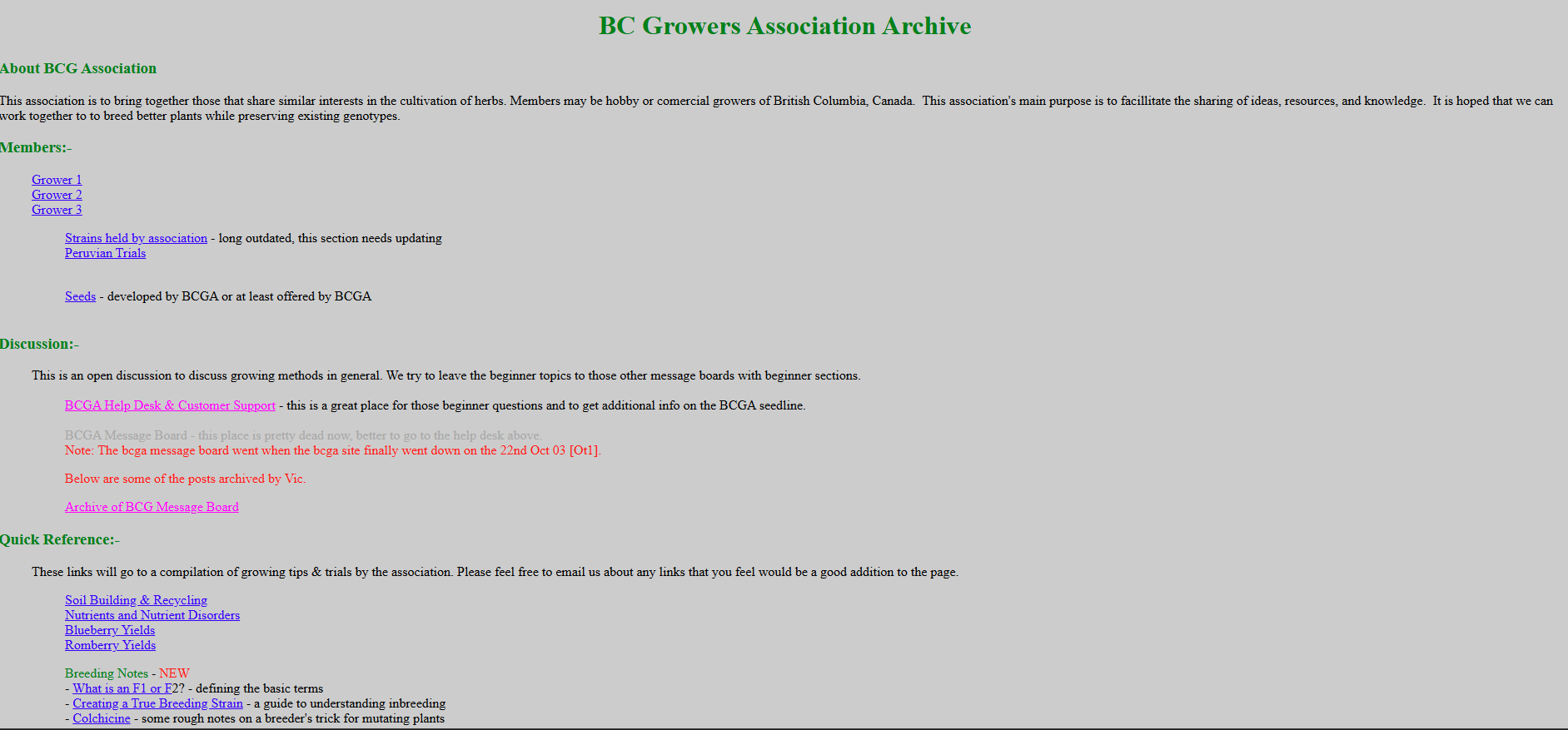
Vic High's clearest statement of purpose comes from the opening of his own genetics article, written in February 1999. He was tired, by that point, of watching cannabis discussion boards collapse into status contests, and said so directly: the page he was building “isn't about ego trips and pissin contests to see who knows the most.” The goal instead was collaborative, a shared attempt to get the terminology of cannabis breeding right, in public, with anyone willing to “join in.”
He enforced that premise as a moderator, not just a contributor. In April 1999, fielding complaints that the board was drifting into general chat, he laid out what the page was not for: “It's not a coffee shop to socialize,” and just as bluntly, “We are not interested in re-creating the wheel here.” A few weeks later he was still holding the line, redirecting seedbank-comparison questions elsewhere and noting that he tried to “avoid responding to the romberry questions” himself, deferring instead to growers reporting their own experience. The board, in his conception, was an information resource, not a hangout and not a sales channel, including for his own seed line.
That same insistence on substance over performance extended to how he handled disagreement. Responding to a poster needling him in February 1999, he wrote plainly that he didn't “mind my words and ideas being challanged”, disagreement, for him, was how a community “learn new concepts faster.” What he wouldn't tolerate was bad faith: he was, in his words, “disgusted when people bring bullshit and lies to the table.” Open challenge was welcome; manufactured controversy was not.
Underpinning all of it was a personal rule about identity. As far back as August 1998 he stated it as a first principle: “I always have and always will use no other name than my own.” He'd arrived at that rule the hard way, he later described an early mistake of posting an anonymous warning about a minor on the boards, and the shame of it convinced him to never hide behind anonymity again. He treated anonymous posting on the boards generally as a tell: if someone wouldn't put their name to a claim, he assumed they didn't quite believe it themselves. Knowledge-sharing, intellectual openness, and real-name accountability functioned for him as one bundle, not three separate values, you could trust what was said on the board precisely because people had to stand behind it.
Building a Vocabulary for a Black-Market Science
If the forum's premise was sharing information, Vic High's signature project was making sure that information meant something specific. Cannabis breeding terms, F1, F2, IBL, homozygous, heterozygous, were being used loosely across the seed trade, and he set out to fix that, citing actual plant-genetics literature (Clarke's Marijuana Botany, agricultural geneticists like Watts and Grossnickle and Russell) rather than trading in folklore. His stated reason wasn't academic tidiness; it was consumer protection. Inconsistent terminology meant a buyer had no way to know what an “F1” from one seed bank actually represented, and he wanted to “help establish an industry standard” precisely because, as things stood, “a seed bank can call a cross whatever it wants.”
He treated this as an open, correctable project rather than a finished doctrine. When a respondent named MrSoul proposed a refinement to his F2 definition, Vic High welcomed the addition and asked to fold it into “a genetics section at the BCGA webpage” he was building. When another regular, Chimera, caught him overstating a genetic claim, he conceded the point without ego, at one point waving off Chimera's compliment on an earlier post, replying only that there was “still a long ways to go here.” And when Chimera himself overreached, asserting that a particular genetic outcome “will” occur rather than “may,” Vic High pushed back with the same rigor he applied to himself: “Don't you think the word ‘may’ would be more accurate?” The standard he was building applied to everyone in the conversation, including its author, a stance he made explicit elsewhere when fielding a difficult breeding question: “What I say isn't gospel.”
That empiricism extended into his own breeding work. Discussing his ongoing effort to improve his blueberry line, he described selecting against weak, disease-prone plants and toward something hardier and more consistent, summed up, in his own irreverent shorthand, as breeding for “Basically, less bitchy plants.” It's a throwaway line, but it captures something real about his method: theory mattered to him, but it was always in service of a concrete, testable outcome in the flowering room, not abstraction for its own sake.
The December 1999 Reckoning: F2 Knockoffs and the Ethics of the Seed Trade
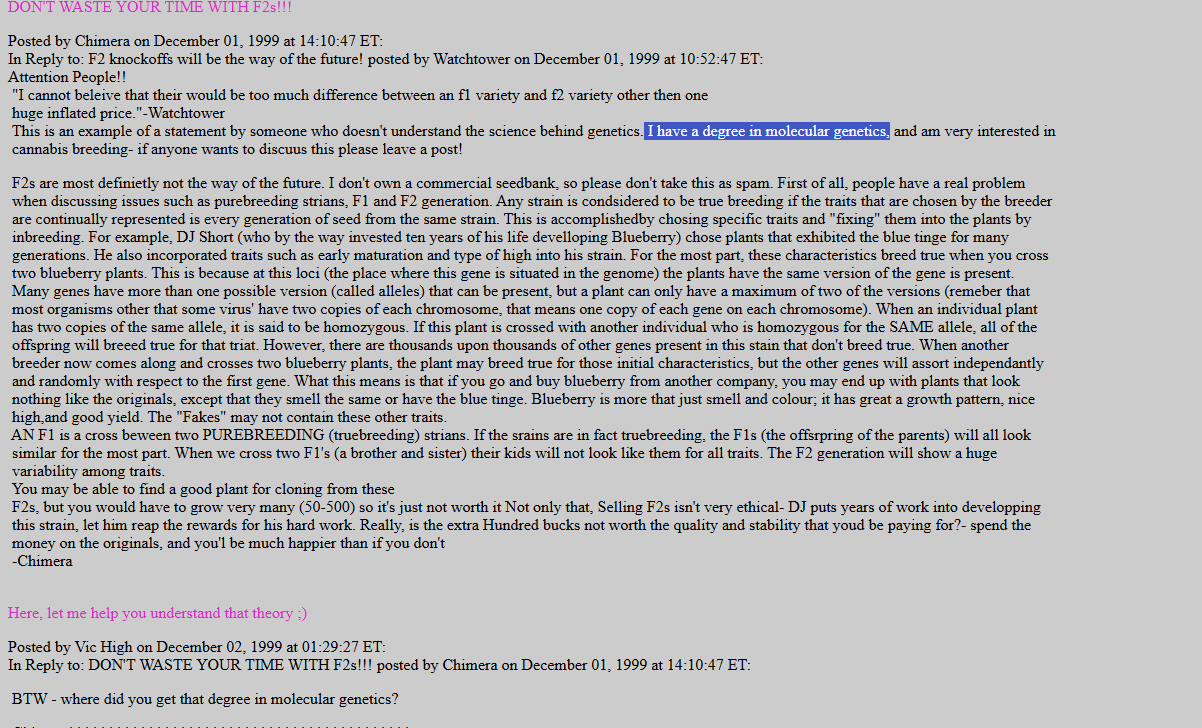
The richest single window into Vic High's commercial ethics is a sprawling argument that ran through the BCGA boards in early December 1999, sparked by a poster predicting that cheap “F2 knockoffs” of popular strains were “the way of the future.” Chimera, a self-described molecular genetics student, answered with a flat moral claim: selling F2 knockoffs was unethical because it stole the value of years of a breeder's selection work without compensating them. Other voices pushed back from the opposite direction, a poster going by “F2 user” defended growing and trading F2s among friends as a harmless, low-stakes practice, arguing that “Anyone producing good bud is doing the right thing,” so long as credit went to the original breeders where it was due.
Vic High's own contributions sat between those poles, and they were grounded in market mechanics rather than moral absolutism. Explaining why true F1 seed costs more, he made a practical case rather than a sentimental one: a real F1 gives a buyer “the best chance of finding a predictible phenotype with the yield and vigour worth momming up,” and, just as important from a breeder's standpoint, F1s are the hardest cross for a knockoff artist to reliably reproduce, which is what actually protects the original breeder's investment. He was equally precise about what counted as a genuine F1 in the first place: “True F1s will be as uniform as a pure breeding strain,” he wrote, pushing back on a poster who was using the term loosely to describe unstable seed stock.
But when the conversation turned explicitly to ethics, Vic High didn't claim the high ground Chimera was offering. Instead he reframed the whole dispute as a question without a universal answer: “We are a multicultural community and ethics will vary from region to region.” His proposed fix wasn't a moral injunction but a governance idea, “get a bunch of the breeders together and openly discuss this” to work out shared guidelines, while acknowledging that knockoffs cut both ways: bad for an individual breeder's incentive to keep innovating, but useful pressure on the whole trade to keep “their prices realistic.”
That same pragmatism showed up in how he ran his own seed operation. He was open, in a February 1999 post answering a customer's email, about pulling business from seed merchants who tried to shortchange BCGA, and about rewarding the ones who dealt fairly, explaining that he wanted retailers to “collect some ethics and clean up their acts” before he'd extend them further access to his genetics. And when Chimera, in a separate exchange, described the wider trade as a “SEEDY business”, breeders going uncredited, seed banks selling stock they never paid for, Vic High didn't dispute the characterization. He agreed it was, in his word, “seedy,” and offered the closest thing to a reform platform that appears anywhere in his writing: the way to clean up an unregulated trade was through informed buyers, with “customers avoiding seedbanks who practice questionable business ethics” rather than chasing hype or discounts. In a market with no enforceable contracts, no trademarks, and no recourse to courts, that was the only lever he had, and he reached for it without illusions about how far it would go.
Working the Land Without Romanticizing It
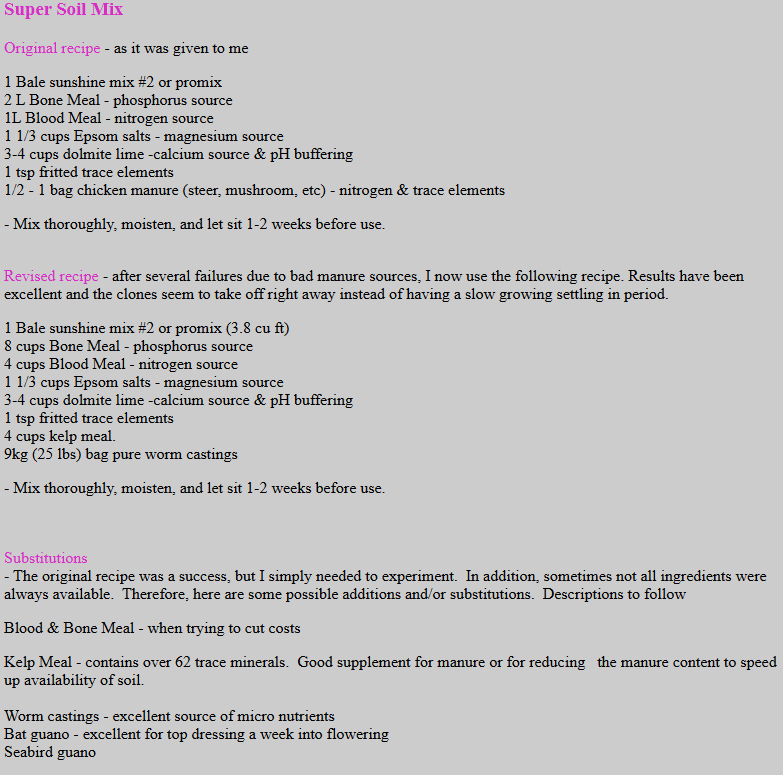
Vic High's organic growing practice reads, on the surface, like simple back-to-the-land sentiment. Writing up his soil recipe, he described why he reused composted soil year after year rather than buying fresh bales: it kept his garden self-contained, drew less attention from anyone watching his consumption patterns, and reflected a broader commitment, “I believe in working with nature, not against it.” But his thinking on environmental questions, expressed more directly during a July 1999 exchange about organic versus chemical growing, was considerably less sentimental than that line suggests on its own. Pushed to explain why environmental responsibility mattered to a grower whose whole enterprise depended on indoor lighting and chemical inputs, he rejected the premise of nature-for-its-own-sake outright: “We don't try and save the environment for the environment's sake, it couldn't give a shit what we do to it. It simply adapts.” The reason to act responsibly, in his framing, was self-interest, “We protect it for our own benefit”, He also wrote, “we sometimes need to do things because it's the right thing to do.”He elaborated that position the following day, conceding that his own lifestyle “isn't what you would call environmentally friendly” and that “everything we do has an environmental pricetag,” his own existence included. His standard wasn't purity; it was a kind of rolling cost-benefit accounting, where a more expensive but lower-impact choice could be worth supporting even at a near-term loss, since broader adoption would eventually bring the cost down, recycled paper, he pointed out, only became cheap because enough people supported it while it was still expensive. It's a grower's version of an economist's argument for collective action, not an environmentalist's appeal to the sanctity of nature.
Mutual Aid in a Hostile Legal Climate
Running parallel to the genetics and business-ethics material is a quieter thread about what the BCGA community owed its own members when the law caught up with one of them. Twice in the archive, for a California grower known as A1, busted in mid-1999, and again for an internet figure known as Aeric77, arrested at the end of that year, Vic High organized seed auctions and donated a portion of his own stock specifically to cover legal fees. His framing for the A1 fund was unambiguous: “I propose to donate 1/3 of my proceeds from this remaining stock to contribute to A1's legal defence.”
What's notable is how carefully he handled the appearance of self-interest inside that generosity. Around the same time he was raising money for Aeric77's defense, he was also negotiating to acquire breeding rights to one of Aeric77's rarer clones, and he flagged the overlap to the whole board unprompted, under the heading “Full disclosure,” rather than let anyone discover it later. He didn't deny the optics were awkward; he simply stated plainly that his “desire to help Aeric has nothing to do with my desire to cube his clone,” and let the record stand for others to judge. For a man operating in a community with no formal ethics process, voluntary, public disclosure was the substitute mechanism, the same instinct that drove his real-name policy on the boards.
Security, Snitches, and the Limits of Vengeance
Vic High's posts also sketch a working code of conduct for surviving as a target of law enforcement without becoming, as he asked, a “REAL” criminal. Asked how to handle an informant, he counseled against escalation on both practical and almost superstitious grounds: “I personally wouldn't want to hurt my persoanl karma by killing a snitch,” he wrote, arguing that social consequences, being permanently labeled and shunned within the community, did more lasting damage to an informant than violence would, concluding flatly that “You only hurt yourself by killing snitches, a very dumb idea.”
That same risk-aware realism showed up in his security advice to other growers. He was insistent that personal information, addresses, contact details, never be posted publicly on the boards, telling one well-meaning poster offering help that “personal info is not welcome here, period.” And he was unsentimental about the legal exposure that came with growing at any scale at all, telling a poster weighing how many plants was “safe” that there was no such threshold: “you risk a criminal record with even 1 light.” Operational caution, for him, wasn't paranoia; it was just an accurate read of the odds.
A Rare Political Rant
Vic High mostly kept his posts technical, but on at least one occasion in early 2000 he let a broader political view through, and flagged it himself afterward as unusual: “A rare polital rant by Vic, haha.” Responding to another poster's complaint about government overreach, he extended the comparison all the way out: governments, in his view, “are really nothing more than organized crime,” using taxation as protection money and treating property rights as a revocable privilege rather than a genuine entitlement, “The land does not really belong to us despite what is written on paper.”
That skepticism of state authority didn't translate into passivity, though. A few weeks later, watching BC's cannabis growers absorb one-sided media coverage, he argued for an organized counter-offensive rather than withdrawal: “BC growers definately need to start fighting back politically,” he wrote, proposing that growers do the investigative work themselves, “doing the reporter's work for them”, to get accurate numbers on pricing and potency in front of journalists who might eventually report them.
His own partisan self-description, offered later that same spring, was harder to pin down than either the anti-government rant or the activist instinct would suggest on their own. He described having been an early member of Canada's Reform Party before its first election, drawn by its candor, only to watch it curdle into ordinary party politics; and he placed himself loosely with fiscal conservatives, calling himself “a self employed free enterprise type” who resented high taxation and an oversized social safety net. It's a position that sits uneasily next to the legal-defense fundraisers and the genetics-sharing ethic discussed above, a free-market individualist who nonetheless poured real time and money into voluntary collective institutions his community had no other way of building.
The Throughline: Transparency as the Antidote to a “Seedy” Trade
Read across genetics, business practice, growing philosophy, mutual aid, and politics, the same basic move recurs in Vic High's writing: identify a place where unaccountable power or unverifiable claims let someone get away with bad behavior, and answer it with a mechanism the whole community could check for itself. Loose breeding terminology let seed banks sell whatever they wanted under an F1 label, so he built a glossary anyone could hold them to. An anonymous poster's claim couldn't be weighed against their reputation, so he tied his own words permanently to his own name. A seed-trade conflict of interest could fester in private, so he disclosed his own conflicts before anyone asked. A government's claim to legitimate authority rested on taking property rights as a given, so he treated that claim as just another unverified assertion. Even his fix for the F2-knockoff problem, informed customers punishing bad actors with their wallets, was the same idea applied to commerce: not a moral appeal, but a verification mechanism standing in for the regulator his industry would never have.
That doesn't make him a tidy ideologue. The same person arguing that government is dressed-up organized crime also spent real money funding other growers' legal defenses and built, more or less by hand, the closest thing his corner of the cannabis world had to a regulatory standard. He wasn't trying to reconcile those instincts into a single political theory, and there's no evidence in the archive that he saw any tension there at all. What he was doing, more modestly, was building, post by post, recipe by recipe, defense fund by defense fund, the institutions of trust that an outlaw trade couldn't get from anywhere else, on the theory that if nobody else was going to hold this business to a standard, the growers themselves would have to.
Epilogue: After the Boards
The BCGA archive ends in March 2000, but the record doesn't. Vic High died on March 23, 2018, confirmed by independent tribute threads that went up within a day or two of his death on both Overgrow.com and THCFarmer.com, with several posters noting that Subcool had announced it on Instagram. The tributes are consistent on what he was remembered for: the Super Soil recipe documented in his own writing above, still called “legendary” by growers fifteen-plus years on; Romberry and Orange Crush, both traceable to the breeding work described in his 1999 posts; and two strains not present anywhere in the BCGA archive itself but credited to him with striking consistency across more than a dozen independent commercial seed-bank listings, Killer Queen (a cross of an Airborne G13/HP clone with a Brothers Grimm Cinderella 99 male) and Space Queen (Romulan crossed with Cinderella 99), the latter still sold today and still describing itself, on seed-bank pages with no connection to one another, as “created by Vic High of the BC Growers Association.”
One thread in the tributes lands harder than the others. Multiple independent posters, on ICMag in 2010, on Overgrow in 2018 and again in 2019, on Rollitup in 2022, allege that the breeder known as Subcool used Vic High's Super Soil recipe and Space Queen genetics commercially without full credit, with one 2019 account claiming the soil recipe was sold to High Times without his knowledge. None of this is independently verifiable beyond its being a recurring, independently-repeated claim across separate communities years apart, so it belongs here as allegation, not established fact. But if it happened anything like the way it's described, it's a genuinely difficult irony: the same man who spent December 1999 arguing that the cannabis seed trade needed buyers willing to punish breeders who didn't give credit where it was due may himself have become a case study in exactly that failure.