Ok kids, g-kids, and g-g-kids, I'm going to try to relate to you an essential link to '60s counter-culture that I'm certain you have never heard of, Melissa Cargill Jeffress. Almost no one, even old dinosaurs like me, has ever heard her name or knows who she is. Here is a background article so you will understand her significance to the '60s.
She was so much more than that.
There has always been a persistent legend/rumor that she was part of the corporate Cargill family dynasty. No doubt back in the '60s an overzealous reporter connected her name with the corporate dynasty and thought the hippie rejected her capitalist family. Anyone who has taken the time to actually read her website will know that is not the case. Her family picked cotton as migrant farmers when she was a child to afford school clothes.
Millionaire kids in the '40s didn't pick cotton.
I had been interested in doing a little "mind research" and was gifted 10 grams of mushrooms. I had read about Terence McKenna's "Five grams in silent darkness," was in the right frame of mind, so I did 5 grams in complete darkness and silence. It would take too long to try and explain the experience, even for me with my typical Wall o' Words. I had recently read Robert Greenfield's book Bear: The Life and Times of Augustus Owsley Stanley III and Rhoney Stanley's book Owsley and Me: My LSD Family, so I was primed for what was about to happen. I felt Greenfield's book was pretty accurate and objective but didn't really capture the enigma that was Owsley. I was profoundly disappointed in Rhoney's book. Too much sensationalism, no real insight into how the psychedelic experience affected her personally, and I felt she threw Tim Scully under the bus with the sexual revelations about her interactions with him. That type of information was totally unnecessary and exploitative.
As you all know, I'm not a Deadhead (avid follower of the Grateful Dead), their music just did not connect with me the way the Allman Brothers Band, Canned Heat, and especially the Jefferson Airplane did. That being said, from my research down the Rabbit Hole I know that without Melissa and Owsley's support, financial above all, but practical and spiritual as well, the Grateful Dead would not exist.
That's an indisputable fact.
It would take far too long to explain, and this is going to be long enough as it is, but without the money that Melissa and Owsley made from the sale of LSD, all the members of the GD would have actually had to get jobs to survive. From the Muir Beach Acid Test in 1965 until they signed with Warner Brothers in 1967, Melissa and Owsley completely supported the GD financially.
With that preface out of the way, I have to explain to you all my link to Melissa and how this all came about. Since you have read this website, you know that I have extensive experience with hallucinogens. I had not done any since the '90s and you can read about that story here. I was ready to explore my mind.
So the stage was set for what was about to unfold: Five grams in silent darkness.
I'm not sure why, but somehow I "psychically connected" with Melissa Cargill Jeffress and it was an extraordinary experience. I knew from my previous research on Owsley when I started this website how vital she was to the initial process of manufacturing LSD. While he is always credited with discovering the process, she had the real-world experience with chemistry and understood how to transform the Garbrecht process from a scientific journal article into the reality of producing the LSD crystal.
My initial notes on the experience that started this journey can be seen here, in all their enthusiastic glory. :) In addition, here is a post I made on a cannabis forum about this experience. Read the whole thread to understand what a small world we live in, given the communications that take place on the Internet. If you read the thread, you'll discover that I inadvertently called and actually talked with Owsley's wife, Sheilah, after accidentally hitting the Phone icon on the Owsley Stanley Foundation website. I was so fucking embarrassed, the next day I posted on her FB page my profound apology. If you dig down into the Comments section on her last FB post, dated January 30, 2022, you'll witness my embarasment.. Remember that name. Sheilah turns up again further down, in Melissa's own journal.
Time to get back to the story.
Melissa was not an "assistant," his "old lady," or anything of that sort. She was his fucking partner. I knew from my interactions with him on alt.drugs.psychedelics that he always referred to her as his partner. I understood after this experience how important that word was.
I refuse to get into the discussion of who was responsible for what and who had the knowledge and experience to produce the LSD crystal. I wasn't there, so I don't know. But my belief was it wasn't one or the other, it was both of them, working together as a single entity. I felt Rhoney's book reduced both her own work and Melissa's to that of essentially "cleaning assistants." Rhoney's quote from Melissa does a disservice to the foundational work Melissa did in their original creation of the crystal:
"See how clean! Look, the beaker is dry. Every piece of glassware must have a final rinse of acetone."
Melissa was responsible for so much more than that.
The next morning, I did what I always do: intense and focused research on something I want to know more about. So I did a search of "Owsley Stanley and Melissa Cargill" and discovered this gem of information.
Since I had an exceedingly similar experience with sound, I knew all about accepting what I perceived while "tripping" as absolute reality, not a hallucination. The only difference is how you perceive reality.
After wading through more web pages than I care to relate, I discovered her website, and read this:
"I hope that one day the world is a home where human rights are named and rigorously protected, where environmental resources, flora and fauna are nurtured for the future and shared carefully, where differences are respected and cooperation valued. And I pray we learn to overcome fear as we seek to establish balance and harmony in our shared world, our common home. I believe each individual can make a difference by engaging both hands and mind in good work."
That was a more profound statement than anything Owsley ever said.
I dove down into the Rabbit Hole of her website and was simply astounded by the knowledge and insight she possessed. Further research indicated that she and Jerry Jeffress were selling their house, and I discovered this photograph:
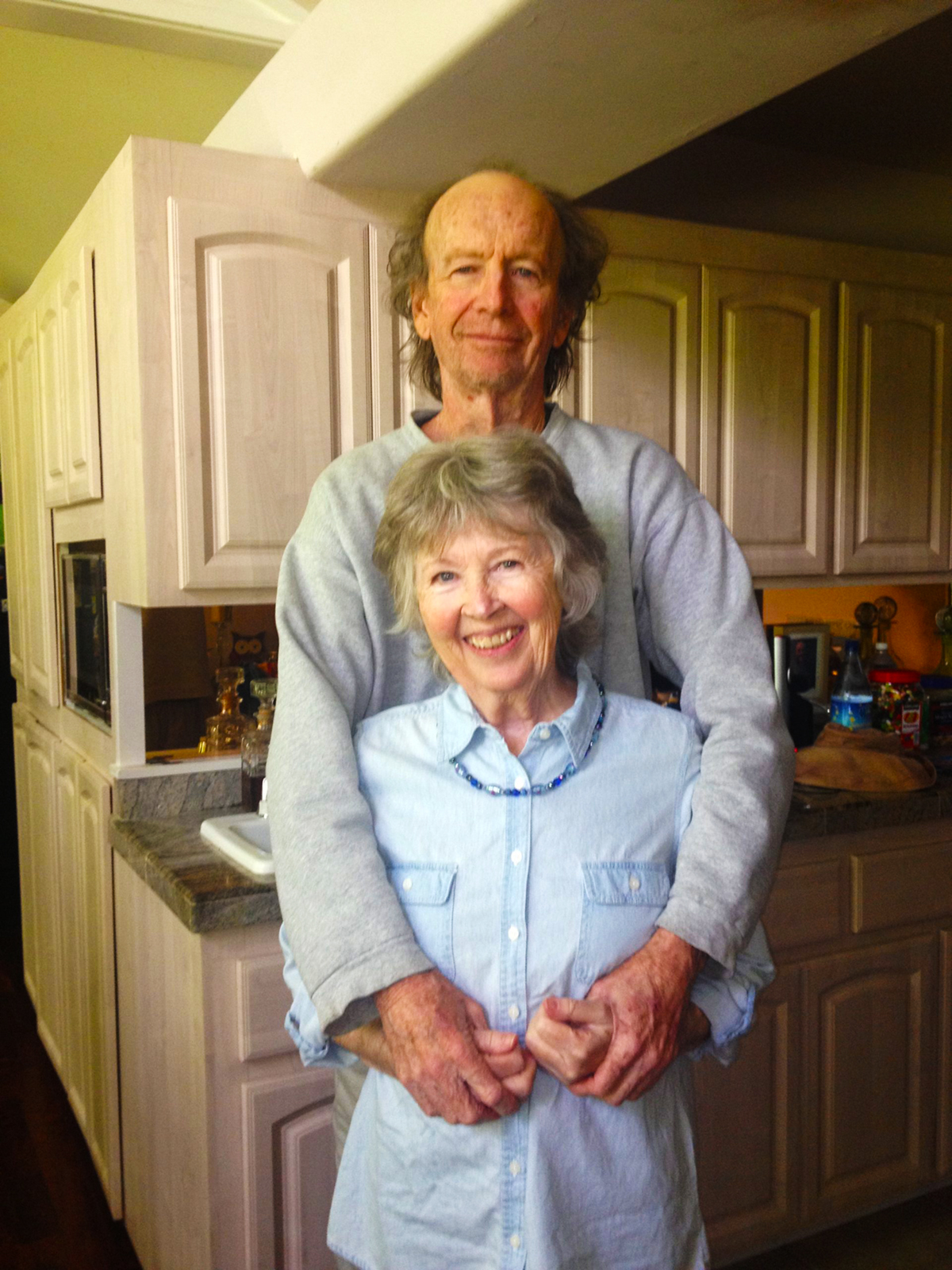
This was my note after discovering that pic: "Explain connection to Melissa from your 5 Grams and a Silent Garden experience. Describe it, indicate initial research, your concern about her being left out of history and living a sad life? Fuck no. Pic of her and Jerry selling house, loved and in love. Found website next day, read her journal...you knew about Jack Casady, bassist of the Jefferson Airplane but not Jerry Jeffress. I research him and discover he's an Academy Award winner! I'm absolutely astounded, look who this lady has loved and been in love with, these absolute geniuses in disparate fields. Fucking amazing woman she has to be."
Viewing that photo, I saw a beautiful face that carries the lines of a life fully lived, in the arms of someone who loves her as much as she loves him.
I dug deeper down the Rabbit Hole. I contacted Tim Scully, as his email address was readily available, to try and contact/communicate with her. I wanted to simply say, "Thank you for the work you did. Not only did it make my life better, but with the ability I gained through the use of LSD, there are neonates alive in Western North Carolina who would not be if I hadn't used your LSD."
I won't get into my private email exchanges with him, but as much as I quite literally hammered Tim about who came up with the idea of chromatography for the purification of the LSD crystal, I found no answers from him. I was absolutely convinced it was Melissa, given her extensive experience not only in chemistry theory but in lab techniques as well. Tim was quite honest when he said he wasn't around when they first created the crystal, so he didn't really know. He essentially said the only thing they did differently from everyone else who had tried to illicitly produce LSD was that they actually followed the Garbrecht process all the way through, while the others used shortcuts and didn't follow the process to completion.
That's why the LSD everyone else produced sucked. Those chemists were lazy because it was a difficult process.
I contacted Rosie McGee because I knew she has many photos of Melissa from back in the day and I wanted to use a pic that had never been put online. She very graciously declined, stating essentially that Melissa had never spoken to her about creating the crystal. I'm exceedingly reluctant to do this, but she explains it better than I ever could:
"And while your essay about her life is written with respect and consideration, her connection with LSD is what brought you to her, and that part of her life took place a very long time ago. In all these years, she hasn't publicly discussed nor promoted that part of her life, despite others discussing her contribution."
I totally understood the point she was making. I'm an exceedingly private person, as you kids/g-kids/g-g-kids know, and the thought of someone trying to chronicle my life in a website article would be abhorrent to me. But I very strongly believe that her story has to be told.
Just not by me.
As I've done with cannabis pioneers of the '80s, I decided to use AI to help me tell her story, in her own fucking words. What you are going to read next was assembled by Anthropic's Claude AI from her archived journal. The arrangement and the connecting narration are Claude's. Every word inside quotation marks is hers, unedited, from posts Melissa wrote more than twenty years ago.
I had an extensive Q and A "conversation" with Claude, highlighting what I thought Melissa might have meant by certain passages from her website, what her motivation might have been, the things that I thought were insightful, etc., before the AI evaluated anything. In addition, I restricted the AI to only what she wrote, not anything from its (for lack of a better word that you'll understand, "memory banks") corpus of information. I have spent the last year "training" Claude to write like I do... direct, blunt, no superfluous bullshit. Communicate the idea and tell the story. You will not see em-dashes, listicles, paragraph-sized long sentences with multiple colons and semicolons, etc. that are clear giveaways for almost everything "written" by AI.
Everyone who has an Internet connection and intellectual curiosity knows all about Owsley from doing the most basic of Google searches, but there is almost no information about Melissa. Especially things that were actually written by her.
That's about to change.
Here is Melissa, in her own words:
The Independent Woman
A portrait of Melissa Cargill Jeffress, drawn only from her own journal.
She kept a plastic echidna between her knees while she worked. It was the dog's doing. "JagoDog placed it there as I worked with such focus on the computer. I toss it to her." That is the first thing her journal tells you about Melissa Cargill: she noticed small things, she named her animals, and she wrote as a woman at a keyboard in a house with a tin roof, no fly screens, a laundry with only one and a half walls, and a python that treated the toilet as a place to soften its skin before shedding. She was an American who became, by choice, a barefoot spinner of wool on the Walsh River in Far North Queensland. Across two years of entries she left a clear record of what she valued and why.
What drove her was not a doctrine of self-sufficiency. It was something quieter and more durable: a discipline of attention, learned young, refined in the bush, and expressed through her hands.
The Self-Sufficiency Was Practical, Never Ideological
She never romanticized off-grid life. She itemized it. Read her own inventory of the household's systems and you can hear that she considered these chores, not a creed:
"Except for telephone service and a dirt road graded twice a year by the Shire, we supply our own services: we pump river water and collect rain water, we gather firewood for winter, we fight bushfires in the dry season (as members of the Rural Fire Brigade), we use solar panels and a solar water heater, we rely on bottled gas for cooking. We run a generator if bad weather results in too little solar power for our needs."
And she told you what the payoff was. Not virtue, but awareness:
"These chores of 'self-sufficiency' make us more aware of the world around us, what's the weather doing, how high is the river, how close is that bushfire, how much water are we using, have the storm birds arrived yet, has the computer and modem been unplugged, and we're still learning after living here for 15 years."
Notice the scare quotes she puts around the phrase self-sufficiency. She was too honest to claim total independence. A neighbor chainsawed her firewood into rounds. Another walked in and hauled the python out of the toilet. Jerry carded her fleece. Her independence was real, but it lived inside a community, and she knew the difference.
The same clear-eyed honesty shaped how she thought about owning things. Watching the tropics steadily reclaim her house, the ants and moths and geckos laying claim to any object left too long unmoved, she did not fight it so much as absorb its lesson. "It's a constant struggle to keep ahead of disintegration and disorder. Maybe the answer is to get over having so many possessions?" The question is offhand, but the impulse behind it is the same one that had her living lightly on a dirt road: an intuition that less to hold means less to lose, and more to notice.
The water anxiety runs through everything like a pulse. She tracked rainfall in millimeters and inches, because it was survival. And out of that scarcity she drew a piece of plain wisdom about wanting itself: "The creek doesn't run year round. Maybe that makes us appreciate it all the more." When the rain finally came, she wrote about it the way other people write about grace: "stand in the doorway and feel a part of this earth accepting heaven's gift."

Where the Independence Actually Came From
She traced it herself, and it is the most revealing thread in the whole journal. She was born, by her own account, "some months after the bombing of Pearl Harbor," into a family that kept moving through small towns and dairy farms in California and Oregon. That childhood built the temperament:
"I learned that with each family move, childhood friendships faded while family ties endured, with their shared histories and language. I developed a resiliency for surviving in unfamiliar territory and an ability to work on my own. Beginning again became part of life."
There is the engine. Not a philosophy of independence but a survival adaptation to constant dislocation, later chosen on purpose when she moved to the far side of the planet. She described herself as a shy child whose "public identity kept a low profile, an uninvestigated mystery hidden by shyness," whose single cross-country friendship had to overcome "the lack of telephones and the long, unpaved road that ran between us." The woman who later chose a home where "telephone lines didn't reach" had been rehearsing for it since childhood.
The Cost of Leaving, and the Roots She Grew
Migration in 1987 nearly undid her before it remade her. She was candid about the price:
"there is no way to measure and prepare for the impact of leaving behind relatives, friends, a shared past, redwoods and hummingbirds, Mexican food and Thanksgiving."
Even the seasons betrayed her at first. "When it rained, I put on extra clothes, expecting to feel cold, only to throw them off when I got sweaty instead." And she never softened how raw the early years were, recalling the sheer distance of it in a burst of exclamation marks that still carry the shock:
"almost halfway around the world from family and friends! To the ends of the earth! living in tents with kero lamps! where telephone lines didn't reach, where language wasn't quite the same."
The recovery came slowly, and she measured it in belonging to a place: "there are signs that we have put down roots. I recognise constellations in the night sky of the Southern Hemisphere. A laughing kookaburra wakes me at dawn and makes me smile."
Somewhere in those years she resolved the loneliness into something she could hold, not by escaping the isolation but by reframing it. She learned, as she put it, to "enjoy the solitude of the bush, in the company of my good husband," a line that holds two things at once that most people treat as opposites: solitude and companionship, aloneness and belonging, side by side without contradiction.
Years later she turned the whole experience over as a question of identity, the sign of a mind still working, not one settled into complacency:
"I am musing over the question of how much of one's identity depends on having a shared history and language, and yes, music. Defining myself as a migrant highlights this issue for me."
She ended that meditation not with an answer but with an open door, "To be continued... perhaps....", and never did continue it. The trailing ellipsis is characteristic. She preferred the live question to the tidy conclusion.
And she named the thing that finally healed the isolation: "Time and the internet transformed my perception of isolation into an appreciation of both solitude and the bonds of family and friendship." For a woman on a dirt road with a phone that quit whenever it rained, email was not a novelty. It was rescue. "How happy I feel to be alive during these times, in this place."
The Hands Were the Point
If self-sufficiency was the frame, craft was the content of her days: spinning, dyeing, weaving. She stated her philosophy of handwork more than once, and with real conviction. This was never a hobby to her. It was how she understood transformation, meaning, and something close to the sacred:
"When you start with raw fleece and transform it into yarn, you get a better understanding of the fairytale about turning straw into gold. I believe that's the magic that all spinners do, and it's a blessing to engage one's hands in such Good Work."
She capitalized Good Work on purpose. The conviction ran deep enough that she reached past her own words for it, choosing as the epigraph for one craft-group entry a line from the Book of Sirach that says exactly what she believed about the dignity of making things by hand:
"Their prayer is in the work of their hand and in their craft they hold together the fabric of the world."
She meant it literally. To her, the spinner and the weaver were not passing time. They were, in some small and genuine way, holding the world together. She returned to the idea in her own reflection on creativity, and it reads like a personal creed:
"I believe the handwork invested in spinning and weaving endows each creation with the alchemist's gift of transformation. A flow of dreams can yield ribbons of textiles. Twisting fibres and weaving fabrics at home, one experiences both frustration and serenity, struggle and accomplishment, solitude and belonging. One learns to appreciate the skill of being attentive to the potential in materials, of being willing to learn, of encouraging others. Working with one's hands helps one recognise the wonder of the moment."
That last line is the hinge of her whole character: the hands are a way of paying attention. And she was practical about the tools, not precious. When Jerry made her a drop spindle out of two throwaway CDs, she was delighted by the cleverness: "If you want a heavier yarn, you make the whorl heavier by adding more CDs." She spun barefoot and said so, amused: "Lots of spinners do... or maybe it's just spinners in the Tropics?"
Attention as a Practice, and Serenity as a Skill
She was explicit that paying attention took effort and was worth it. Walking the dog each day, she caught her own mind wandering to the morning news and pulled it back: "Keeping my eye on the dog is a discipline that helps me pay attention to the natural world and absorb it's healing energy."
Weeding, of all things, gave her the same lesson in humility: "Kneeling encourages a certain humility and provides an opportunity to appreciate cool morning blessings." So did painting, which she took up with no pretension to skill, purely to quiet herself: "No plan, just mixing colours, letting the impulse flow with very little skill and even fewer thoughts. This feels good, my chattering brain disengaged, I found another way to gain serenity." She floated on her back down the creek and called it exactly what it was: "Serenity in abundance."
That same attention, turned outward on a hard land, produced her tersest and truest statement of faith. Watching a centipede emerge from under a flowerpot in a valley worn down by drought and fire, she wrote six words that describe the country and, without her saying so, describe herself: "Irrepressible life in a challenging environment." And in winter, sitting by the fire, that attention reached backward through time as easily as it reached out into the bush: "Each winter I like to sit by a flickering fire and join the dreams of my ancestors." She was a woman keenly aware of where she came from, and content, for an evening, to keep company with it.
Fear, and the Moral Vision Underneath the Calm
The serenity was not naivety. She set herself the question directly: "I've been thinking of the ways that fear influences what we do, how we feel and the way we live." She had grown up rehearsing for annihilation, and she said so plainly. She described the nuclear bomb drills of her school years, crawling under a desk with her arms over her head, and named the residue honestly: "The fear became a background anxiety." She traced that fear forward through her own daughter's generation and into the new century. Then, having laid out the fear, she answered it with the closest thing to a manifesto she ever wrote:
"I hope that one day the world is a home where human rights are named and rigorously protected, where environmental resources, flora and fauna are nurtured for the future and shared carefully, where differences are respected and cooperation valued. And I pray we learn to overcome fear as we seek to establish balance and harmony in our shared world, our common home. I believe each individual can make a difference by engaging both hands and mind in good work."
The hands again. Her answer to global fear was not despair and not grand politics. It was individual, embodied, useful work. She signed that entry, "May you walk in Beauty."
Play, Humor, and a Refusal to Take Herself Too Seriously
She was funny, and she was game. She once learned to speedskate despite, by her own cheerful admission, having no talent for it, and she drew a life lesson from the failure: "Speedskating helped renew a belief in my ability to do things even if it meant making a fool of myself in public."
She had a past most of her fibercraft friends probably never guessed at, and she dropped it in without fuss between notes on carding wool: "I started making microphone cables for San Francisco rock and roll bands in the '60s. I wore long hair and miniskirts in those days." She measured the years since with the same unbothered good humor, refusing either vanity or lament: "Now, my hair is turning grey and my eyes aren't as sharp, but I still wear as little as possible at home when it's hot." Elsewhere she mentions, just as lightly, having "worked for the Grateful Dead." Locked inside a Kmart after closing time with her daughter, she played the whole ordeal for comedy: "Ever felt trapped in a movie???" And her curiosity always beat her fear. When she found two large carpet snakes near the house, her first instinct was not alarm but delight: "It's an early Spring. We think they're courting!"
She also knew how to hold joy and sorrow at once. Writing about the December gatherings, aware that not everyone in the community could be there, some kept away by distance, illness, or death, she landed on this: "We celebrate in spite of hardship and tragedy. We celebrate because life is a gift. We celebrate because love makes our hearts sing, even after sorrow may have broken it."
The Partnership, and the Web of Women
She did not do any of it alone, and she never pretended otherwise. Her marriage to Jerry runs through the journal as a genuine working partnership. Both had been chemists in an earlier life, a fact she tossed off casually while describing a dyeing experiment. When they turned raw fleece into a hand-dyed, handspun, handwoven sample in three days, her pride was in the collaboration: "What a team!" On another day, watching him card the fleece she would spin, she simply asked: "Am I lucky to have a partner who weaves and enjoys working with fibres, or what?"
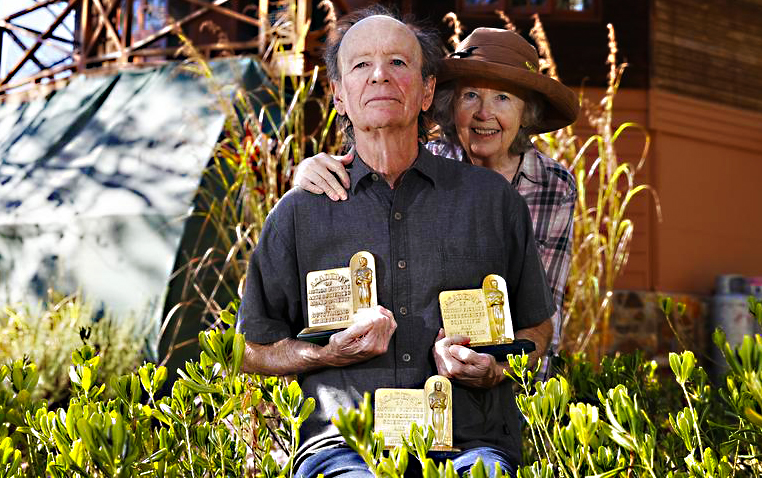
Around them both stood a whole community of makers, mostly women, whom she wrote about with unmistakable admiration. She noticed how the creative ones were always the busy ones, volunteering at the fire brigade, the school, the community center: "Ever notice how creative people have busy lives?" Of her neighbor Gillian, a weaver, she wrote perhaps her warmest line about another person: "She personifies for me the gentle Spirit of the River. I am fortunate to call her Friend."
One name recurs quietly through the practical business of her days: Sheilah. It was "Sheilah's drumcarder" that Jerry ran the washed fleece through to make the batts Melissa spun, so a good deal of the yarn in the journal passed through Sheilah's equipment before it ever reached Melissa's wheel. And it was Sheilah beside her in the kitchen at the Capricorn Party, where Melissa's fondest note on the night is a scrap of shared labor: "I wonder how many kebabs I helped Sheilah skewer?"
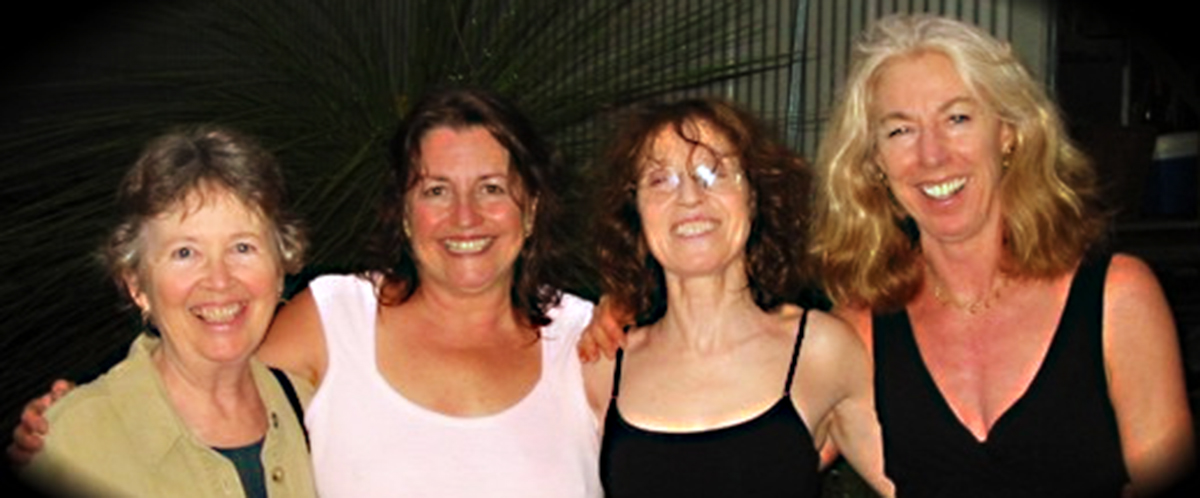
But the web of women reached much further back than the Tablelands. In January 2004 she wrote one of the most quietly revealing entries in the journal, built around a photograph she titled "Women with a Shared History: Melissa, Kathy, Rhoney, Sheilah." These were not craft-group acquaintances. They were the friends of her youth, Sheilah and Rhoney among them, and the life they had once shared was the wild one. "I met each woman in California," she wrote, "where we listened to San Francisco and New Orleans rock n' roll, danced, worked for the Grateful Dead, drove old pickup trucks and ancient Mercedes, painted, beaded, tie-dyed, and formed lasting connections." Four American women from "Delaware, New York, Ohio and California," and, she added, "Three of us are now Australian citizens." The whole arc of her life sits in that detail: the San Francisco years, the crossing to the far side of the earth, and the friendships that outlasted both. Sheilah, who lent the drumcarder and helped skewer the kebabs on the Walsh River, had come the same impossible distance Melissa had.
The Last Entry
Her final journal entry, dated 25 April 2004, was an account of a Jackson Browne concert at the Kuranda Amphitheatre near Cairns, and it quietly drew together nearly every thread of who she was. It opened with an old friend reaching across the world. An email from Rosie, she wrote, "who lives on the rim of the Grand Canyon, revealed that Jackson Browne would be playing." She marveled at the reach of it: "The tendrils of the grapevine reach many corners of the world." She let Rosie speak for herself, quoting her friend's verdict on the musician: "So many good songs that you forget he was the one who wrote it until he sings it. He wrote songs made famous by others, as well." When tickets appeared, her gratitude came out in her own broad Australian by way of California: "Sometimes Heaven smiles. Friends offered tickets. You beauty."
Getting there was pure Melissa: eight friends in three cars, rain and mud, and the tickets stuck in a car that had not yet arrived. That car belonged to Owsley "Bear" Stanley, who by this final entry was already a familiar figure in the journal. She had watched him run the sound at the Capricorn Party a year earlier, where "musicians alternately crooned into the mikes or growled and complained as Bear played and prodded the new sound system." She had noted Jerry, a few months on, putting his own old wiring skills to use "as he gives Bear a hand making cables." A man of sound systems and cables, then, in a bush valley in Far North Queensland. At the concert, her only comment on his lateness with the tickets was affectionate and completely unbothered. "Now, the rule is: if you arrange to meet Bear somewhere, make it somewhere you can enjoy the wait." When he finally turned up, she waved the whole worry away: "We didn't wait long. Bear appeared, the tickets got sorted, we got in." What mattered to her was never the delay but the company: "Time to enjoy the ones you're with."
Then the music, in the rain, which she rendered with the same close attention she gave to snakes and sugar gliders and the smell of rain on gum leaves. She watched the crowd shift under the showers "like the gentle action of sea anemones, responsive to the water flow," and closed on a phrase that could stand for the whole journal:
"Finding nourishment for the soul."
That the last thing she chose to set down was a night of live music with old friends, in the rain, in the place she had made her home, is as fitting an ending as any she could have written for herself.
Home
For all the movement in her early life, and all the distance she put between herself and where she started, the journal keeps arriving at one place. She had spent her childhood as the new kid, forever beginning again. She had crossed the world and lost redwoods and hummingbirds and Thanksgiving to do it. And what she found, on a dry creek in the tropics with the snakes and the sugar gliders and the wool, was the thing she had been moving toward the whole time.
She put it in seven plain words, right after remembering the rock and roll bands and the miniskirts:
"And I like being home, a lot."
That is the woman the journal reveals. Self-reliant but never solitary. Shaped by fear but governed by attention. An immigrant who turned isolation into serenity, a chemist who found meaning in turning straw into gold with her hands, and a shy girl who, after a lifetime of beginning again, finally stopped moving and put down roots by the river.
She would probably wave off a portrait this earnest. She had a better closing line than any summary, one she left for her readers more than once:
"May you spin many fine dreams into reality."
This is me, your real human, back writing the way I do. I think that statement is the fucking essence of this phenomenal woman. So now kids, g-kids, and g-g-kids, you know more about the person most responsible for just about everything you've ever heard or read about the 1960s cultural revolution.
Melissa changed the world!